
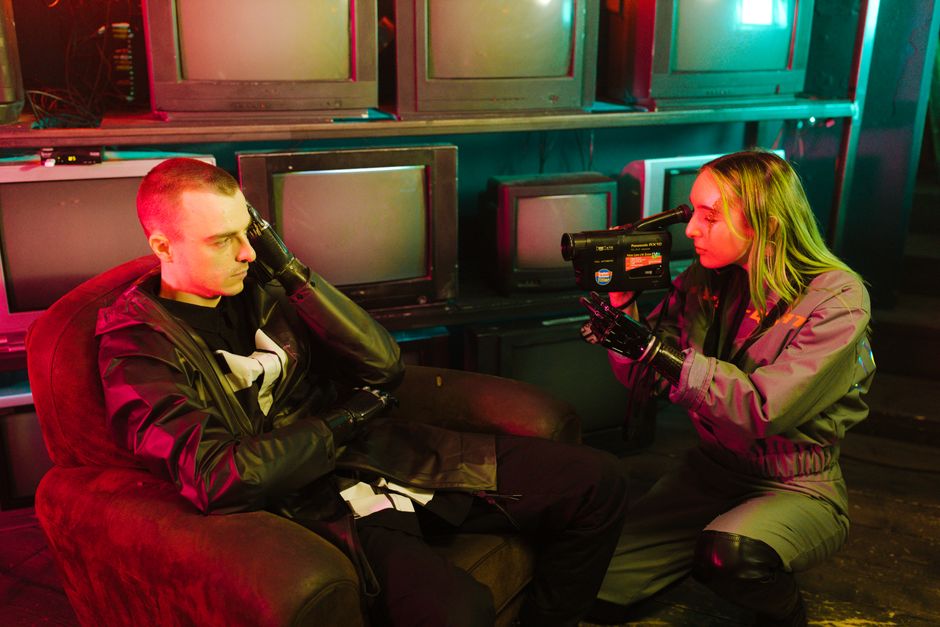
23 September 2025: The Sci-Fi Short Film Haunting the Internet
A Digital Apocalypse: Investigating the Mystery of September 23, 2025
What if the world ended not with a bang, but with a freeze-frame? A viral short film poses this exact question, presenting a chilling enigma that has spawned a thousand theories online. The premise is stark: a lone man navigates a world that is perfectly intact but utterly devoid of human life. The only clue to the catastrophe is a single, repeating data point displayed on every digital screen: September 23, 2025. The film offers no answers, instead presenting a silent world of evidence and inviting the viewer to become the detective.
The Evidence on Screen: A Puzzle Box of Clues
Rather than telling a linear story, the film constructs a meticulous crime scene. Every element, from the soundscape to the setting, serves as a piece of a larger, unexplained puzzle, forcing the audience to question the nature of the protagonist’s reality.
Clue #1: The Digital Constant
The date is the central mystery. Its uniform presence on phones, monitors, and public displays suggests a systemic, technological event. This is not a natural disaster; it’s a digital ghost in the machine, a line of code that has brought reality to a halt. The specificity of the date implies a trigger, a moment when some unseen system either failed or executed a final, world-altering command.
Taking the next step becomes straightforward when you have the right support — Get the best book with practical guides on digital communication essentials is worth exploring.
Taking the next step becomes straightforward when you have the right support — Become an Ultimate Master of your life is worth exploring.
Clue #2: The Interrupted World
The environment itself is a haunting testament to a moment frozen in time. The world isn’t ruined, it’s paused. Cars sit in traffic lanes, coffee cups are still warm on desks, and homes are filled with the artifacts of lives abruptly stopped. This pristine preservation rules out conventional apocalyptic scenarios. Humanity wasn’t wiped out; it was surgically removed, leaving behind a perfect, silent diorama of the moment it vanished.
Decoding the Event: Three Dominant Theories
The film’s ambiguity has made it a canvas for audience interpretation. Online communities have tirelessly worked to piece together the clues, with several compelling theories emerging as the most plausible explanations for the silent apocalypse.
The Simulation Hypothesis: A System Crash
Perhaps the most popular theory is that the protagonist is living in a simulation that has crashed. In this view, he is either the sole user left in a defunct program or an NPC who has gained awareness. The frozen date is the system’s fatal error message, and the empty world is the result of all other assets being de-rendered. The oppressive silence is simply the absence of programmed ambient noise, revealing the artificiality of his world.
The Temporal Fracture: Trapped Between Moments
Another interpretation suggests the event is not technological, but physical. A temporal anomaly or a physics experiment gone wrong could have fractured time itself, trapping the protagonist in an infinitesimally small loop of a single moment. The world isn’t empty; everyone else is simply frozen in the nanosecond before and after his perception. He is a man walking through the gap between ticks of a broken clock.
The Quarantine Scenario: A Grand Experiment
A more sinister theory posits that the event is a deliberate, controlled experiment. An unseen intelligence—be it an advanced AI, alien entity, or future human faction—has placed the protagonist in a state of absolute isolation to study him. The world is a meticulously crafted prison, and the date is a marker for the experiment’s start. This reframes his solitude not as an accident, but as a carefully imposed condition.
The Power of an Unsolved Mystery
Ultimately, the film’s enduring appeal lies in its refusal to provide a definitive answer. It is a narrative Rorschach test, reflecting our deepest contemporary fears about technology, reality, and isolation. By leaving the puzzle unsolved, it transforms the viewer from a passive observer into an active participant in the story. The film’s true genius is not the world it presents, but the endless questions it inspires long after the screen goes dark.